The quotes for this author need curating

We’d love for you to do it. If you’re not yet registered as a curator, you’ll first need to do so.

What does curating involve?   |   Benefits    |    Register

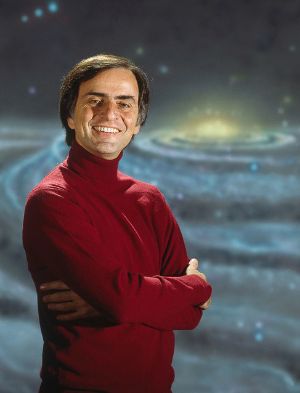
About Carl Sagan


Carl Edward Sagan (1934 – 1996) was an American astronomer, planetary scientist, cosmologist, astrophysicist, astro-biologist, author, and science communicator. Wikipedia

References:  Encyclopaedia Britannica 


Quotes by Carl Sagan

Carl Sagan (quotes)

  • But I could be wrong.
  • We are all star stuff.
  • We are made of star stuff.
  • War is murder writ large.
  • All colours are arbitrary.
  • Real patriots ask questions.
  • Not all bits have equal value.
  • Who will speak for Planet Earth?
  • Valid criticism does you a favor.
  • We are all made up of star stuff.
  • Nobody listens to mathematicians.
  • The open road still softly calls.
  • Understanding is a kind of ecstasy
  • To read is to voyage through time.
  • We can always take but never give.
  • Every star may be a sun to someone.
  • What an astonishing thing a book is.
  • We were wanderers from the beginning.
  • We are one species. We are star stuff.
  • We are star stuff harvesting sunlight.
  • Your god is too small for my universe.
  • We can’t help it. Life looks for life.
  • Science is a way to not fool ourselves.
  • I don’t want to believe. I want to know.
  • We are the universe experiencing itself.
  • We are the custodians of life’s meaning.
  • An organism at war with itself is doomed.
  • The illegality of cannabis is outrageous.
  • Cleverly designed experiments are the key.
  • Science is only a Latin word for knowledge
  • We are a way for the cosmos to know itself.
  • We are a way of the universe knowing itself.
  • He didn’t want to believe. He wanted to know.
  • Wisdom lies in understanding our limitations.
  • My wonder button is being pushed all the time.
  • With insufficient data it is easy to go wrong.
  • There is never only ONE of anything in nature.
  • Science has itself become a kind of religion.
  • We live on a mote of dust suspended in a sunbeam
  • Stars are phoenixes, rising from their own ashes.
  • Extraordinary claim requires extraordinary proof.
  • You are worth about 3 dollars worth in chemicals.
  • Extinction is the rule. Survival is the exception.
  • Extraordinary claims demand extraordinary evidence
  • The cosmos is within us. We are made of star stuff
  • We began as wanderers, and we are wanderers still.
  • Across the sea of space, the stars are other suns.
  • If we ruin the earth, there is no place else to go
  • The visions we offer our children shape the future.
  • All inquiries carry with them some element of risk.
  • This oak tree and me, we’re made of the same stuff.
  • Who are we, if not measured by our impact on others?
  • You have to know the past to understand the present.
  • Writing is perhaps the greatest of human inventions.
  • We are the children equally of the Sky and the Earth.
  • The Cosmos is all that is or ever was or ever will be.
  • Our passion for learning … is our tool for survival.
  • The passion to explore is at the heart of being human.
  • Man is the matter of the cosmos, contemplating itself.
  • Somewhere, something incredible is waiting to be known.
  • The absence of evidence is not the evidence of absence.
  • All civilizations become either spacefaring or extinct.
  • The Earth is a very small stage in a vast cosmic arena.
  • Any civilization that doesn’t develop space travel dies.
  • Observation: I can’t see a thing. Conclusion: Dinosaurs.
  • If the press descended, the science would surely suffer.
  • Don’t judge everyone else by your own limited experience.
  • A book is proof that humans are capable of working magic.
  • Better the hard truth, I say, than the comforting fantasy.
  • The surface of the Earth is the shore of the cosmic ocean.
  • There is in this Universe much of what seems to be design.
  • The universe forces those who live in it to understand it.
  • We are, in the most profound sense, children of the Cosmos.
  • Otherwise we don’t run the government the government runs us
  • Nothing disturbs me more than the glorification of stupidity.
  • Sailors on a becalmed sea, we sense the stirring of a breeze.
  • There are wonders enough out there without our inventing any.
  • Where we have strong emotions, we’re liable to fool ourselves.
  • Man is a transitional animal. He is not the climax of creation
  • The sacred truth of science is that there are no sacred truths.
  • We are, each of us, a multitude. Within us is a little universe.
  • Science is a way of thinking that helps you not to fool yourself.
  • We are star stuff which has taken its destiny into its own hands.
  • It means nothing to be open to a proposition we don’t understand.
  • The universe seems neither benign nor hostile, merely indifferent.
  • The price we pay for anticipation of the future is anxiety about it
  • Books break the shackles of time, proof that humans can work magic.
  • If you are only skeptical, then no new ideas make it through to you.
  • It’s hard to kill a creature once it lets you see its consciousness.
  • Atoms are mainly empty space. Matter is composed chiefly of nothing.
  • Our loyalties are to the species and the planet. We speak for Earth.
  • Other things being equal, it is better to be smart than to be stupid.
  • Even through your hardest days, remember we are all made of stardust.
  • You’re capable of such beautiful dreams and such horrible nightmares.
  • Science is a way of thinking much more than it is a body of knowledge.
  • We are like butterflies who flutter for a day and think it is forever.
  • We go about our daily lives understanding almost nothing of the world.
  • I would suggest that science is, at least in my part, informed worship.
  • Preserve and cherish the pale blue dot, the only home we’ve ever known.
  • Ask courageous questions. Do not be satisfied with superficial answers.
  • We are the first species to have taken our evolution into our own hands.
  • To live in the hearts of others is to never die in those we leave behind.
  • For small creatures such as we the vastness is bearable only through love.
  • The universe is not required to be in perfect harmony with human ambition.
  • Ours is the first generation that has grown up with science-fiction ideas.
  • It does no harm to the romance of the sunset to know a little bit about it.
  • The open road still softly calls, like a nearly forgotten song of childhood
  • The cosmos is all there is, all there ever was, and all there ever will be.
  • Books permit us to voyage through time, to tap the wisdom of our ancestors.
  • How smart does a chimpanzee have to be before killing him constitutes murder?
  • And you are made of a hundred trillion cells. We are, each of us, a multitude.
  • Our concern for the future can be tested by how well we support our libraries.
  • One of the great commandments of science is: ‘Mistrust arguments from authority.’
  • In exchange for freedom of inquiry, scientists are obliged to explain their work.
  • Be grateful everyday for the brief but magnificent opportunity that life provides.
  • If you wish to make an apple pie from scratch, you must first invent the universe.
  • As the ancient myth makers knew, we are children equally of the earth and the sky.
  • Extraordinary observations require extraordinary evidence to make them believable.
  • Science is far from a perfect instrument of knowledge. It’s just the best we have.
  • But down deep, at the molecular heart of life we’re essentially identical to trees.
  • Books are key to understanding the world and participating in a democratic society.
  • Curiosity and the urge to solve problems are the emotional hallmarks of our species.
  • Humans are very good at dreaming, although you’d never know it from your television.
  • Whatever the reason you’re on Mars, I’m glad you’re there, and I wish I was with you.
  • What’s the harm of a little mystification? It sure beats boring statistical analyses.
  • There are as many atoms in one molecule of DNA as there are stars in a typical galaxy.
  • The cure for a fallacious argument is a better argument, not the suppression of ideas.
  • Maxwell’s Equations have had a greater impact on human history than any ten presidents.
  • The Earth is a place. It is by no means the only place. It is not even a typical place.
  • UFOs: The reliable cases are uninteresting and in the interesting cases are unreliable.
  • Imagination will often carry us to worlds that never were. But without it we go nowhere.
  • The universe is a pretty big place. If it’s just us, seems like an awful waste of space.
  • If you want to make a [rhubarb] pie from scratch, first you have to create the universe.
  • If we continue to accumulate only power and not wisdom, we will surely destroy ourselves.
  • The brain is like a muscle. When it is in use we feel very good. Understanding is joyous.
  • Science is not only compatible with spirituality; it is a profound source of spirituality.
  • we make our world significant by the courage of our questions and the depth of our answers
  • The words “question” and “quest” are cognates. Only through inquiry can we discover truth.
  • First rule in government spending: why build one when you can have two at twice the price?
  • The sky calls to us. If we do not destroy ourselves, we will one day venture to the stars.
  • Football is a thinly disguised re-enactment of hunting; we played it before we were human.
  • Human beings have a demonstrated talent for self-deception when their emotions are stirred.
  • Any sufficiently crisp question can be answered by a single binary digit-0 or 1, yes or no.
  • Except in pure mathematics, nothing is known for certain (although much is certainly false).
  • If you want to save your child from polio, you can pray or you can inoculate….Try science.
  • In the deepest sense the search for extraterrestrial intelligence is a search for ourselves.
  • Not all birds can fly. What separates the flyers from the walkers is the ability to take off.
  • Science is merely an extremely powerful method of winnowing what’s true from what feels good.
  • Not explaining science seems to me perverse. When you’re in love, you want to tell the world.
  • [Kepler] preferred the hard truth to his dearest illusions, and that is the heart of science.
  • We are not smart enough to decide which pieces of knowledge are permissible and which are not.
  • At the extremes it is difficult to distinguish pseudoscience from rigid, doctrinaire religion.
  • For a long time the human instinct to understand was thwarted by facile religious explanations.
  • But nature is always more subtle, more intricate, more elegant than what we are able to imagine.
  • We on Earth have just awakened to the great oceans of space and time from which we have emerged.
  • The simplest thought, like the concept of the number one, has an elaborate logical underpinning.
  • Human history can be viewed as a slowly dawning awareness that we are members of a larger group.
  • One’s inability to invalidate your hypothesis is not at all the same thing as proving it true.
  • In all our searching, the only thing we’ve found that makes the emptiness bearable is each other.
  • If we do not speak for Earth, who will? If we are not committed to our own survival, who will be?
  • The notion that science and spirituality are somehow mutually exclusive does a disservice to both.
  • There are more potential combinations of DNA [physical forms] than there are atoms in the universe.
  • Those who seek power at any price detect a societal weakness, a fear that they can ride into office.
  • For all our failings, despite our limitations and fallibilities, we humans are capable of greatness.
  • The fact that some geniuses were laughed at does not imply that all who are laughed at are geniuses.
  • We are made of star-stuff. Our bodies are made of star-stuff. There are pieces of star within us all.
  • It is said that men may not be the dreams of the god, but rather that the gods are the dreams of men.
  • I don’t know the answer. Maybe no one knows. Maybe when you grow up, you’ll be the first to find out.
  • Books are like seeds. They can lie dormant for centuries and then flower in the most unpromising soil.
  • In the vastness of the Cosmos there must be other civilizations far older and more advanced than ours.
  • I find science so much more fascinating than science fiction. It also has the advantage of being true.
  • If we say that God has always been, why not save a step and conclude that the universe has always been?
  • I think the discomfort that some people feel in going to the monkey cages at the zoo is a warning sign.
  • The beauty of a living thing is not the atoms that go into it, but the way those atoms are put together.
  • The candle flame gutters. Its little pool of light trembles. Darkness gathers. The demons begin to stir.
  • We’ve arranged a civilization in which most crucial elements profoundly depend on science and technology.
  • Except for fools and madmen, everyone knows that nuclear war would he an unprecedented human catastrophe.
  • Any faith that admires truth, that strives to know God, must be brave enough to accommodate the universe.
  • I would be very ashamed of my civilization if we did not try to find out if there is life in outer space.
  • In the vastness of space and the immensity of time, it is my joy to share a planet and an epoch with Annie.
  • For years I’ve been stressing with regard to UFOs that extraordinary claims require extraordinary evidence.
  • I believe that the extraordinary should be pursued. But extraordinary claims require extraordinary evidence.
  • One of the greatest gifts adults can give – to their offspring and to their society – is to read to children.
  • When we look up at night and view the stars, everything we see is shinning because of distant nuclear fusion.
  • If all the suns but ours collapsed tonight, how many lifetimes would it take us to realize that we were alone?
  • The method of science, as stodgy and grumpy as it may seem, is far more important than the findings of science.
  • Organic as a dandelion seed, [the ship of our imagination] will carry us to worlds of dreams and worlds of facts
  • Advances in medicine and agriculture have saved vastly more lives than have been lost in all the wars in history.
  • There are no forbidden questions in science, no matters too sensitive or delicate to be probed, no sacred truths.
  • I hold that popularization of science is successful if, at first, it does no more than spark the sense of wonder.
  • We have entered, almost without noticing, an age of exploration and discovery unparalleled since the Renaissance.
  • The old appeals to racial, sexual and religious chauvinism to rabid nationalist fervor, are beginning not to work.
  • Science is more than a body of knowledge. It’s a way of thinking: a way of skeptically interrogating the universe.
  • Our species needs, and deserves, a citizenry with minds wide awake and a basic understanding of how the world works.
  • The dumbing down of America is evident in the slow decay of substantive content, a kind of celebration of ignorance.
  • There is perhaps no better a demonstration of the folly of human conceits than this distant image of our tiny world.
  • If the greenhouse effect is a blanket in which we wrap ourselves to keep warm, nuclear winter kicks the blanket off.
  • A galaxy is composed of gas and dust and stars – billions upon billions of stars. Every star may be a sun to someone.
  • In science it often happens that scientists say, “You know that’s a really good argument; my position is mistaken…”
  • How lucky we are to live in this time / the first moment in human history / when we are in fact visiting other worlds
  • Human beings grew up in forests; we have a natural affinity for them. How lovely a tree is, straining toward the sky.
  • It is far better to grasp the universe as it really is than to persist in delusion, however satisfying and reassuring.
  • Every cell is a triumph of natural selection, and we’re made of trillions of cells. Within us, is a little universe.
  • It is the tension between creativity and skepticism that has produced the stunning and unexpected findings of science.
  • The total number of stars in the Universe is larger than all the grains of sand on all the beaches of the planet Earth.
  • The fact that someone says something doesn’t mean it’s true. Doesn’t mean they’re lying, but it doesn’t mean it’s true.
  • A celibate clergy is an especially good idea, because it tends to suppress any hereditary propensity toward fanaticism.
  • When you make the finding yourself – even if you’re the last person on Earth to see the light – you’ll never forget it.
  • In the long run, the aggressive civilizations destroy themselves, almost always. It’s their nature. They can’t help it.
  • Writing a novel is like trying to solve a very long mathematical equation. Changing anything can change everything else.
  • Skeptical scrutiny is the means, in both science and religion, by which deep thoughts can be winnowed from deep nonsense.
  • The cosmos is full beyond measure of elegant truths; of exquisite interrelationships; of the awesome machinery of nature.
  • Nature does not always conform to our predispositions and preferences, to what we deem comfortable and easy to understand.
  • The cannabis experience has greatly improved my appreciation for art, a subject which I had never much appreciated before.
  • In our time, we have sifted the sands of Mars, we have established a presence there, we have fulfilled a century of dreams!
  • Our children long for realistic maps of the future that they can be proud of. Where are the cartographers of human purpose?
  • If the constellations had been named in the twentieth century, I suppose we would see bicycles and refrigerators in the sky.
  • The nuclear arms race is like two sworn enemies standing waist deep in gasoline, one with three matches, the other with five.
  • If we are to survive, our loyalties must be broadened further, to include the whole human community, the entire planet Earth.
  • I would love to believe that when I die I will live again, that some thinking, feeling, remembering part of me will continue.
  • In the fabric of space and in the nature of matter, as in a great work of art, there is, written small, the artist’s signature.
  • It is all a matter of time scale. An event that would be unthinkable in a hundred years may be inevitable in a hundred million.
  • All inquires carry with them some element of risk. There is no guarantee that the universe will conform to our predispositions.
  • If we can’t think for ourselves, if we’re unwilling to question authority, then we’re just putty in the hands of those in power.
  • You can’t convince a believer of anything; for their belief is not based on evidence, it’s based on a deep seated need to believe
  • Avoidable human misery is more often caused not so much by stupidity as by ignorance, particularly our ignorance about ourselves.
  • Perhaps the depth of love can be calibrated by the number of different selves that are actively involved in a given relationship.
  • I think if we ever reach the point where we think we thoroughly understand who we are and where we came from, we will have failed.
  • Our ancestors lived out of doors. They were as familiar with the night sky as most of us are with our favorite television programs.
  • We live at a moment when our relationships to each other, and to all other beings with whom we share this planet, are up for grabs.
  • You could just as well say that an agnostic is a deeply religious person with at least a rudimentary knowledge of human fallibility.
  • I’m only a four-dimensional creature. Haven’t got a clue how to visualise infinity. Even Einstein hadn’t. I know because I asked him
  • Has there ever been a religion with the prophetic accuracy and reliability of science? . . . No other human institution comes close.
  • I don?t feel rejected by the sky. I?m a part of it- tiny, to be sure, but everything is tiny compared to that overwhelming immensity.
  • A googolplex is precisely as far from infinity as is the number 1… no matter what number you have in mind, infinity is larger still.
  • It’s sometimes easier to reject strong evidence than to admit that we’ve been wrong, this is information about ourselves worth having.
  • One glance at a book and you hear the voice of another person, perhaps someone dead for 1,000 years. To read is to voyage through time.
  • We live in an in-between universe where things change all right…but according to patterns, rules, or as we call them, laws of nature.
  • There are lots of ways to communicate what we know, but few ways to communicate what we feel. Music is one way to communicate emotions.
  • There is a lurking fear that some things are not ‚Äúmeant” to be known, that some inquiries are too dangerous for human beings to make.
  • The very act of understanding is a celebration of joining, merging, even if on a very modest scale, with the magnificence of the Cosmos.
  • I believe our future depends powerfully on how well we understand this cosmos in which we float, like a mote of dust in the morning sky.
  • We live in a society exquisitely dependent on science and technology, in which hardly anyone knows anything about science and technology.
  • I believe that in every person is a kind of circuit which resonates to intellectual discovery-and the idea is to make that resonance work
  • Some racists still reject the plain testimony written in the DNA that all the races are not only human but nearly indistinguishable. . . .
  • I set before you two ways: You can use your technology to destroy yourselves or to carry you to the planets and the stars. It’s up to you.
  • A still more glorious dawn awaits / not a sunrise, but a galaxy-rise / a morning filled with 400 billion suns / the rising of the milky way
  • Better by far to embrace the hard truth than a reassuring fable. If we crave some cosmic purpose, then let us find ourselves a worthy goal.
  • An atheist has to know a lot more than I know. An atheist is someone who knows there is no god. By some definitions atheism is very stupid.
  • Our ancestors worshipped the Sun, and they were not that foolish. It makes sense to revere the Sun and the stars, for we are their children.
  • We live in a vast and awesome universe in which, daily, suns are made and worlds destroyed, where humanity clings to an obscure clod of rock.
  • I can find in my undergraduate classes, bright students who do not know that the stars rise and set at night, or even that the Sun is a star.
  • The fact that so little of the findings of modern science is prefigured in Scripture to my mind casts further doubt on it divine inspiration.
  • On the day that we do discover that we are not alone, our society may begin to evolve and transform in some incredible and wondrous new ways.
  • Absolute certainty will always elude us. We will always be mired in error. The most each generation can hope for is to reduce the error. . . .
  • Each of us is a tiny being, permitted to ride on the outermost skin of one of the smaller planets for a few dozen trips around the local star.
  • In Mozambique, the story goes, monkeys do not talk, because they know if they utter even a single word some man will come and put them to work.
  • Life is but a momentary glimpse of the wonder of this astonishing universe, and it is sad to see so many dreaming it away on spiritual fantasy.
  • Except for children (who don’t know enough not to ask the important questions), few of us spendtime wondering why nature is the way it is . . .
  • When permitted to listen to alternative opinions and engage in substantive debate, people have been known to change their minds. It can happen.
  • The usual rejoinder to someone who says ‘They laughed at Columbus, they laughed at Galileo’ is to say ‘But they also laughed at Bozo the Clown’.
  • I am often amazed at how much more capability and enthusiasm for science there is among elementary school youngsters than among college students.
  • The size and age of the Cosmos are beyond ordinary human understanding. Lost somewhere between immensity and eternity is our tiny planetary home.
  • Accommodation to change, the thoughtful pursuit of alternative futures are keys to the survival of civilization and perhaps of the human species.
  • Every thinking person fears nuclear war, and every technological state plans for it. Everyone knows it is madness, and every nation has an excuse
  • Modern science has been a voyage into the unknown, with a lesson in humility waiting at every stop. Many passengers would rather have stayed home.
  • We are star stuff which has taken its destiny into its own hands. The loom of time and space works the most astonishing transformations of matter.
  • Our perceptions are fallible. We sometimes see what isn’t there. We are prey to optical illusions. Occasionally we hallucinate. We are error-prone.
  • The prediction I can make with the highest confidence is that the most amazing discoveries will be the ones we are not today wise enough to foresee.
  • The well-meaning contention that all ideas have equal merit seems to me little different from the disastrous contention that no ideas have any merit.
  • We humans appear on the cosmic calendar so recently that our recorded history occupies only the last few seconds of the last minute of December 31st.
  • By looking far out into space we are also looking far back into time, back toward the horizon of the universe, back toward the epoch of the Big Bang.
  • The evidence, so far at least and laws of Nature aside, does not require a Designer. Maybe there is one hiding, maddeningly unwilling to be revealed.
  • Humans – who enslave, castrate, experiment on, and fillet other animals – have had an understandable penchant for pretending animals do not feel pain.
  • Books tap the wisdom of our species — the greatest minds, the best teachers — from all over the world and from all our history. And they’re patient.
  • The visions we offer our children shape the future. It _matters_ what those visions are. Often they become self-fulfilling prophecies. Dreams are maps.
  • There is every reason to think that in the coming years Mars and its mysteries will become increasingly familiar to the inhabitants of the Planet Earth.
  • In more than one respect, the exploring of the Solar System and homesteading other worlds constitutes the beginning, much more than the end, of history.
  • We are made of stellar ash. Our origin and evolution have been tied to distant cosmic events. The exploration of the cosmos is a voyage of self-discovery.
  • It would be wryly interesting if in human history the cultivation of marijuana led generally to the invention of agriculture, and thereby to civilization.
  • Better the hard truth, I say, than the comforting fantasy. And in the final tolling it often turns out that the facts are more comforting than the fantasy.
  • The Big Bang is our modern scientific creation myth. It comes from the same human need to solve the cosmological riddle [Where did the universe come from?]
  • We can judge our progress by the courage of our questions and the depth of our answers, our willingness to embrace what is true rather than what feels good.
  • A new consciousness is developing which sees the earth as a single organism and recognizes that an organism at war with itself is doomed. We are one planet.
  • Our posturings, our imagined self-importance , the delusion that we have some privileged position in the universe are challenged by this point of pale light.
  • We should be teaching our children the scientific method and the reasons for a Bill of Rights. With it comes a certain decency, humility and community spirit.
  • She had studied the universe all her life, but had overlooked its clearest message: For small creatures such as we the vastness is bearable only through love.
  • Every one of us is, in the cosmic perspective, precious. If a human disagrees with you, let him live. In a hundred billion galaxies, you will not find another.
  • We have heard the rationales offered by the nuclear superpowers. We know who speaks for the nations. But who speaks for the human species? Who speaks for Earth?
  • If we long to believe that the stars rise and set for us, that we are the reason there is a Universe, does science do us a disservice in deflating our conceits?
  • My fundamental premise about the brain is that its workings – what we sometimes call “mind” – are a consequence of its anatomy and physiology, and nothing more.
  • If we are merely matter intricately assembled, is this really demeaning? If there’s nothing here but atoms, does that make us less or does that make matter more?
  • Thus the recent rapid evolution of human intelligence is not only the cause of but also the only conceivable solution to the many serious problems that beset us.
  • Where did God come from? If we decide this is an unanswerable question why not save a step and conclude that the origin of the universe is an unanswerable question.
  • We live in a society exquisitely dependent on science and technology and yet have cleverly arranged things so that almost no one understands science and technology.
  • Maybe it’s a little early. Maybe the time is not quite yet. But those other worlds – promising untold opportunities – beckon. Silently, they orbit the Sun, waiting.
  • Demon mean knowledge in Greek, especially about the material world. Science means knowledge in Latin. A jurisdictional dispute is exposed, even if we look no further
  • Frederick Douglas taught that literacy is the path from slavery to freedom. There are many kinds of slavery and many kinds of freedom, but reading is still the path.
  • All of the books in the world contain no more information than is broadcast as video in a single large American city in a single year. Not all bits have equal value.
  • These days there seems to be nowhere left to explore, at least on the land area of the Earth. Victims of their very success, the explorers now pretty much stay home.
  • The method of science is tried and true. It is not perfect, it’s just the best we have. And to abandon it, with its skeptical protocols, is the pathway to a dark age.
  • An atheist is someone who is certain that God does not exist, someone who has compelling evidence against the existence of God. I know of no such compelling evidence.
  • Knowing a great deal is not the same as being smart; intelligence is not information alone but also judgement, the manner in which information is coordinated and used.
  • It will not be we who reach Alpha Centauri, and the other nearby stars. It will be a species very like us – but with more of our strengths and fewer of our weaknesses.
  • A multitude of aspects of the natural world that were considered miraculous only a few generations ago are now thoroughly understood in terms of physics and chemistry.
  • The desire to be connected with the cosmos reflects a profound reality, but we are connected; not in the trivial ways that astrology promises, but in the deepest ways.
  • Every kid starts out as a natural-born scientist, and then we beat it out of them. A few trickle through the system with their wonder and enthusiasm for science intact.
  • The politicians and the religious leaders and the weapons scientists have been at it for a long time and they’ve made a thorough mess of it. I mean, we’re in deep trouble.
  • There are many hypotheses in science which are wrong. That’s perfectly all right: it’s the aperture to finding out what’s right. Science is a self-correcting process.
  • It took the Church until 1832 to remove Galileo ‘s work from its list of books which Catholics were forbidden to read at the risk of dire punishment of their immortal souls.
  • You can get into a habit of thought in which you enjoy making fun of all those other people who don’t see things as clearly as you do. We have to guard carefully against it.
  • Discussing the possibilities of extraterrestrial life: I would love it even if they were short, sullen, grumpy and sexually obsessed. But there just isn’t any good evidence.
  • If our long-term survival is at stake, we have a basic responsibility to our species to venture to other worlds. Sailors on a becalmed sea, we sense the stirring of a breeze.
  • .. Think of the rivers of blood spilled by all those generals and emperors so that in glory and in triumph they could become the ‘Momentary’ masters of a ‘Fraction’ of a ‘Dot’
  • The way to find out about our place in the universe is by examining the universe and by examining ourselves – without preconceptions, with as unbiased a mind as we can muster.
  • Some 5 billion years from now, there will be a last perfect day on Earth… then the sun will begin to die, life will be extinguished, the oceans will boil and evaporate away.
  • The nitrogen in our DNA, the calcium in our teeth, the iron in our blood, the carbon in our apple pies were made in the interiors of collapsing stars. We are made of starstuff.
  • The Hindu religion is the only of the World’s great faiths dedicated to the idea that the Cosmos itself undergoes an immense, indeed an infinite, number of deaths and rebirths.
  • A general problem with much of Western theology in my view is that the god portrayed is too small. It is a god of a tiny world and not a god of a galaxy much less of a universe.
  • Religions are often state-protected nurseries of pseudoscience, although there’s no reason why religions have to play that role. In a way, it’s an artefact from times long gone.
  • Those with the courage to explore the weave and structure of the Cosmos, even where it differs profoundly from their wishes and prejudices, will penetrate its deepest mysteries.
  • Looking at fires when high, by the way, especially through one of those prism kaleidoscopes which image their surroundings, is an extraordinarily moving and beautiful experience.
  • It goes with a courageous intent to greet the universe as it really is, not to foist our emotional predispositions on it but to courageously accept what our explorations tell us.
  • The immense distances to the stars and the galaxies mean that we see everything ins pace int he past, some as they were before the Earth came to be. Telescopes are time machines.
  • Is mankind alone in the universe? Or are there somewhere other intelligent beings looking up into their night sky from very different worlds and asking the same kind of question?
  • My view is that if there is no evidence for it, then forget about it. An agnostic is somebody who doesn’t believe in something until there is evidence for it, so I’m agnostic.
  • What began in deadly competition has helped us to see that global cooperation is the essential precondition for our survival. Travel is broadening. It’s time to hit the road again.
  • Virtually every major technological advance in the history of the human species – back to the invention of stone tools and the domestication of fire – has been ethically ambiguous.
  • In a complex universe, in a society undergoing unprecedented change, how can we find the truth if we are not willing to question everything and to give a fair hearing to everything?
  • I worry that, especially as the Millennium edges nearer, pseudo-science and superstition will seem year by year more tempting, the siren song of unreason more sonorous and attractive.
  • History is full of people who out of fear, or ignorance, or lust for power has destroyed knowledge of immeasurable value which truly belongs to us all. We must not let it happen again.
  • Our planet is a lonely speck in the great enveloping cosmic dark. In our obscurity, in all this vastness, there is no hint that help will come from elsewhere to save us from ourselves.
  • I consider it an extremely dangerous doctrine, because the more likely we are to assume that the solution comes from the outside, the less likely we are to solve our problems ourselves.
  • But I try not to think with my gut. If I’m serious about understanding the world, thinking with anything besides my brain, as tempting as that might be, is likely to get me into trouble.
  • Those afraid of the universe as it really is, those who pretend to nonexistent knowledge and envision a Cosmos centered on human beings will prefer the fleeting comforts of superstition.
  • Science is a collaborative enterprise, spanning the generations. When it permits us to see the far side of some new horizon, we remember those who prepared the way – seeing for them also.
  • The prediction of nuclear winter is drawn not, of course, from any direct experience with the consequences of global nuclear war, but rather from an investigation of the governing physics.
  • The secrets of evolution are death and time-the deaths of enormous numbers of lifeforms that were imperfectly adapted to the environment; and time for a long succession of small mutations.
  • We are at a crossroads in human history. Never before has there been a moment so simultaneously perilous and promising. We are the first species to have taken evolution into our own hands.
  • Our loyalties are to the species and the planet. We speak for Earth. Our obligation to survive is owed not just to ourselves but also to that Cosmos, ancient and vast, from which we spring.
  • We are the only species on the planet, so far as we know, to have invented a communal memory stored neither in our genes nor in our brains. The warehouse of this memory is called the library
  • Both the Freudian and the Platonic metaphors emphasize the considerable independence of and tension among the constituent parts of the psyche, a point that characterizes the human condition.
  • A millennium before Europeans were willing to divest themselves of the Biblical idea that the world was a few thousand years old, the Mayans were thinking of millions and the Hindus billions.
  • And after we returned to the savannahs and abandoned the trees, did we long for those great graceful leaps and ecstatic moments of weightlessness in the shafts of sunlight of the forest roof?
  • The difference between physics and metaphysics is not that the practitioners of one are smarter than the practitioners of the other. The difference is that the metaphysicist has no laboratory.
  • Exploration is in our nature. We began as wanderers, and we are wanderers still. We have lingered long enough on the shores of the cosmic ocean. We are ready at last to set sail for the stars.
  • I also wish that the Pledge of Allegiance were directed at the Constitution and the Bill of Rights, as it is when the President takes his oath of office, rather than to the flag and the nation
  • The understanding of the intent of the artist which I can achieve when high sometimes carries over to when I’m down. This is one of many human frontiers which cannabis has helped me traverse.
  • It is of interest to note that while some dolphins are reported to have learned English – up to fifty words used in correct context – no human being has been reported to have learned dolphinese.
  • I think the health of our civilization, the depth of our awareness about the underpinnings of our culture, and our concern for the future, can all be tested by how well we support our libraries.
  • Science is a way to call the bluff of those who only pretend to knowledge. It is a bulwark against mysticism, against superstition, against religion misapplied to where it has no business being.
  • Science cuts two ways, of course; its products can be used for both good and evil. But there’s no turning back from science. The early warnings about technological dangers also come from science.
  • Who are we? We find that we live on an insignificant planet of a humdrum star lost in a galaxy tucked away in some forgotten corner of a universe in which there are far more galaxies than people.
  • Science is not perfect. It’s often misused; it’s only a tool, but it’s the best tool we have. Self-correcting , ever changing, applicable to everything: with this tool, we vanquish the impossible.
  • How is it that hardly any major religion has looked at science and concluded, ‚ÄúThis is better than we thought! The Universe is much bigger than our prophets said, grander, more subtle, more elegant?
  • There are in fact 100 billion galaxies, each of which contain something like a 100 billion stars. Think of how many stars, and planets, and kinds of life there may be in this vast and awesome universe.
  • I promise to question everything my leaders tell me. I promise to use my critical faculties. I promise to develop my independence of thought. I promise to educate myself so I can make my own judgments.
  • It is clear that the nations of the world now can only rise and fall together. It is not a question of one nation winning at the expense of another. We must all help one another or all perish together.
  • One of the great commandments of science is, ‘Mistrust arguments from authority’. (Scientists, being primates, and thus given to dominance hierarchies, of course do not always follow this commandment.)
  • While our behavior is still significantly controlled by our genetic inheritance, we have, through our brains, a much richer opportunity to blaze new behavioral and cultural pathways on short timescales.
  • Science … looks skeptically at all claims to knowledge, old and new. It teaches not blind obedience to those in authority but to vigorous debate, and in many respects that’s the secret of its success.
  • Modern Darwinism makes it abundantly clear that many less ruthless traits, some not always admired by robber barons and Fuhrers – altruism, general intelligence, compassion – may be the key to survival.
  • We humans look rather different from a tree. Without a doubt we perceive the world differently than a tree does. But down deep, at the molecular heart of life, the trees and we are essentially identical.
  • If I finish a book a week, I will read only a few thousand books in my lifetime, about a tenth of a percent of the contents of the greatest libraries of our time. The trick is to know which books to read.
  • Personally, I would be delighted if there were a life after death, especially if it permitted me to continue to learn about this world and others, if it gave me a chance to discover how history turns out.
  • One trend that bothers me is the glorification of stupidity, that the media is reassuring people it’s alright not to know anything. That to me is far more dangerous than a little pornography on the Internet.
  • A single message from space will show that it is possible to live through technological adolescence. . . . It is possible that the future of human civilization depends on the receipt of interstellar messages.
  • The fossil record implies trial and error, an inability to anticipate the future, features inconsistent with an efficient Great Designer (although not with a Designer of a more remote and indirect temperament)
  • We are an intelligent species and the use of our intelligence quite properly gives us pleasure. In this respect the brain is like a muscle. When we think well, we feel good. Understanding is a kind of ecstasy.
  • We wish to find the truth, no matter where it lies. But to find the truth we need imagination and skepticism both. We will not be afraid to speculate, but we will be careful to distinguish speculation from fact.
  • There are naive questions, tedious questions, ill-phrased questions, questions put after inadequate self-criticism. But every question is a cry to understand the world. There is no such thing as a dumb question.
  • We can make a similar examination, but with greater uncertainty, of the extraterrestrial hypothesis that holds that a wide range of UFOs viewed on the planet Earth are space vehicles from planets of other stars.
  • When Kepler found his long-cherished belief did not agree with the most precise observation, he accepted the uncomfortable fact. He preferred the hard truth to his dearest illusions, that is the heart of science.
  • If we’re capable of conjuring up terrifying monsters in childhood, why shouldn’t some of us, at least on occasion, be able to fantasize something similar, something truly horrifying, a shared delusion, as adults?
  • People are not stupid. They believe things for reasons. The last way for skeptics to get the attention of bright, curious, intelligent people is to belittle or condescend or to show arrogance toward their beliefs.
  • A blade of grass is a commonplace on Earth; it would be a miracle on Mars. Our descendants on Mars will know the value of a patch of green. And if a blade of grass is priceless, what is the value of a human being?
  • If chimpanzees have consciousness, if they are capable of abstractions, do they not have what until now has been described as ‘human rights’? How smart does a chimp have to be before killing him constitutes murder?
  • Much of human history can, I think, be described as a gradual and sometimes painful liberation from provincialism, the emerging awareness that there is more to the world than was generally believed by our ancestors.
  • They (i. e., the Pythagoreans) did not advocate the free confrontation of conflicting points of view. Instead, like all orthodox religions, they practised a rigidity that prevented them from correcting their errors.
  • Writing is perhaps the greatest of human inventions, binding together people who never knew each other, citizens of distant epochs. Books break the shackles of time. A book is proof that humans are capable of magic.
  • Which aspects of our nature will prevail is uncertain, particularly when our visions and prospects are bound to one small part of the small planet Earth. But up there in the Cosmos an inescapable perspective awaits.
  • We are the product of 4.5 billion years of fortuitous, slow biological evolution. There is no reason to think that the evolutionary process has stopped. Man is a transitional animal. He is not the climax of creation.
  • There is a report that says that kids who watch violent TV programs tend to be more violent when they grow up. But did the TV cause the violence, or do violent children preferentially enjoy watching violent programs?
  • For all I know we may be visited by a different extraterrestrial civilization every second Tuesday, but there’s no support for this appealing idea. The extraordinary claims are not supported by extraordinary evidence.
  • There is today-in a time when old beliefs are withering-a kind of philosophical hunger, a need to know who we are and how we got here. It is an on-going search, often unconscious, for a cosmic perspective for humanity
  • Who are we, if not measured by our impact on others? That’s who we are! We’re not who we say we are, we’re not who we want to be – we are the sum of the influence and impact that we have, in our lives, on others.
  • Even today the most jaded city dweller can be unexpectedly moved upon encountering a clear night sky studded with thousands of twinkling stars. When it happens to me after all these years it still takes my breath away.
  • Every time you look up at the sky, every one of those points of light is a reminder that fusion power is extractable from hydrogen and other light elements, and it is an everyday reality throughout the Milky Way Galaxy.
  • The suppression of uncomfortable ideas may be common in religion or in politics, but it is not the path to knowledge; it has no in the endeavor of science. We do not know in advance who will discover fundamental insights.
  • I maintain there is much more wonder in science than in pseudoscience. And in addition, to whatever measure this term has any meaning, science has the additional virtue, and it is not an inconsiderable one, of being true.
  • Few scientists now dispute that today’s soaring levels of carbon dioxide and other gases in the atmosphere will cause global temperature averages to rise by as much as nine degrees Fahrenheit sometime after the year 2000.
  • Probably a dozen times since their death I’ve heard my mother or father, in an ordinary conversational tone of voice, call my name. They had called my name often during my life with them … It doesn’t seem strange to me.
  • We are made of star stuff. For the most part, atoms heavier than hydrogen were created in the interiors of stars and then expelled into space to be incorporated into later stars. The Sun is probably a third generation star.
  • Cutting off fundamental, curiosity-driven science is like eating the seed corn. We may have a little more to eat next winter but what will we plant so we and our children will have enough to get through the winters to come?
  • Once we overcome our fear of being tiny, we find ourselves on the threshold of a vast and awesome Universe that utterly dwarfs ‚Äî in time, in space, and in potential ‚Äî the tidy anthropocentric proscenium of our ancestors.
  • The uniqueness of humans has been claimed on many grounds, but most often because of our tool-making, culture, language, reason and morality. We have them, the other animals don’t, and — so the argument goes — that’s that.
  • All of the rocky and metallic material we stand on, the iron in our blood, the calcium in our teeth, the carbon in our genes were produced billions of years ago in the interior of a red giant star. We are made of star stuff.
  • The illegality of cannabis is outrageous, an impediment to full utilization of a drug which helps produce the serenity and insight, sensitivity and fellowship so desperately needed in this increasingly mad and dangerous world.
  • If intelligence is our only edge, we must learn to use it better, to shape it, to understand its limitations and deficiencies — to use it as cats use stealth, as katydids use camouflage — to make it the tool of our survival.
  • It seems madness to say, ‘We’re worried that they’re going to become addicted to marijuana’ — there’s no evidence whatever that it’s an addictive drug, but even if it were, these people are dying, what are we saving them from?
  • In a lot of scientists, the ratio of wonder to skepticism declines in time. That may be connected with the fact that in some fields-mathematics, physics, some others-the great discoveries are almost entirely made by youngsters.
  • If we teach only the findings and products of science – no matter how useful and even inspiring they may be – without communicating its critical method, how can the average person possibly distinguish science from pseudoscience?
  • I’d like the [Cosmos] series to be so visually stimulating that somebody who isn’t even interested in the concepts will just watch for the effects. And I’d like people who are prepared to do some thinking to be really stimulated.
  • We are prodding, challenging, seeking contradictions or small, persistent residual errors, proposing alternative explanations, encouraging heresy. We give our highest rewards to those who convincingly disprove established beliefs.
  • For all its material advantages, the sedentary life has left us edgy, unfulfilled, even after 400 generations in villages and cities, we haven’t forgotten: The open road still softly calls like a nearly forgotten song of childhood.
  • When you look more generally at life on Earth, you find that it is all the same kind of life. There are not many different kinds; there’s only one kind. It uses about fifty fundamental biological building blocks, organic molecules.
  • What a marvelous cooperative arrangement – plants and animals each inhaling each other’s exhalations, a kind of planet-wide mutual mouth-to-stoma resuscitation, the entire elegant cycle powered by a star 150 million kilometers away.
  • But the fact that some geniuses were laughed at does not imply that all who are laughed at are geniuses. They laughed at Columbus, they laughed at Fulton, they laughed at the Wright Brothers. But they also laughed at Bozo the Clown.
  • Many religions have attempted to make statues of their gods very large, and the idea, I suppose, is to make us feel small. But if that’s their purpose, they can keep their paltry icons. We need only look up if we wish to feel small.
  • Arguments from authority carry little weight ‚Äì authorities have made mistakes in the past. They will do so again in the future. Perhaps a better way to say it is that in science there are no authorities; at most, there are experts.
  • Religions are tough. Either they make no contentions which are subject to disproof or they quickly redesign doctrine after disproof. … near the core of the religious experience is something remarkably resistant to rational inquiry.
  • Cosmos is a Greek word for the order of the universe. It is, in a way, the opposite of Chaos. It implies the deep interconnectedness of all things. It conveys awe for the intricate and subtle way in which the universe is put together.
  • The fact is that far more crime and child abuse has been committed by zealots in the name of God, Jesus and Mohammed than has ever been committed in the name of Satan. Many people don’t like that statement, but few can argue with it.
  • Our intelligence is imperfect, surely, and newly arisen; the ease with which it can be sweet-talked, overwhelmed, or subverted by other hardwired propensities – sometimes themselves disguised as the cool light of reason – is worrisome.
  • But amid much elegance and precision, the details of life and the Universe also exhibit haphazard, jury-rigged arrangements and much poor planning. What shall we make of this: an edifice abandoned early in construction by the architect?
  • Clutching our crystals and religiously consulting our horoscopes, our critical faculties in steep decline, unable to distinguish between what’s true and what feels good, we slide, almost without noticing, into superstition and darkness.
  • We have begun to contemplate our origins: starstuff pondering the stars; organized assemblages of ten billion billion billion atoms considering the evolution of atoms; tracing the long journey by which, here at least, consciousness arose.
  • After the earth dies, some 5 billion years from now, after it’s burned to a crisp, or even swallowed by the Sun, there will be other worlds and stars and galaxies coming into being – and they will know nothing of a place once called Earth.
  • The vast distances that separate the stars are providential. Beings and worlds are quarantined from one another. The quarantine is lifted only for those with sufficient self-knowledge and judgment to have safely traveled from star to star.
  • The lifetime of a human being is measured by decades, the lifetime of the Sun is a hundred million times longer. Compared to a star, we are like mayflies, fleeting ephemeral creatures who live out their lives in the course of a single day.
  • My parents were not scientists. They knew almost nothing about science. But in introducing me simultaneously to skepticism and to wonder, they taught me the two uneasily cohabiting modes of thought that are central to the scientific method.
  • Science is based on experiment, on a willingness to challenge old dogma, on an openness to see the universe as it really is. Accordingly, science sometimes requires courage – at the very least the courage to question the conventional wisdom.
  • Anything else you’re interested in is not going to happen if you can’t breathe the air and drink the water. Don’t sit this one out. Do something. You are by accident of fate alive at an absolutely critical moment in the history of our planet.
  • If we are not able to ask skeptical questions, to interrogate those who tell us that something is true, to be skeptical of those in authority, then, we are up for grabs for the next charlatan (political or religious) who comes rambling along.
  • A central lesson of science is that to understand complex issues (or even simple ones), we must try to free our minds of dogma and to guarantee the freedom to publish, to contradict, and to experiment. Arguments from authority are unacceptable.
  • A religion old or new, that stressed the magnificence of the universe as revealed by modern science, might be able to draw forth reserves of reverence and awe hardly tapped by the conventional faiths. Sooner or later such a religion will emerge.
  • Philosophers and scientists confidently offer up traits said to be uniquely human, and the monkeys and apes casually knock them down — toppling the pretension that humans constitute some sort of biological aristocracy among the beings on Earth.
  • Time spent with children is time well spent. Their little minds are not constrained by ‘reality’ or focused upon goals. Anything and everything is possible. Imagination will often carry us to worlds that never were. But without it we go nowhere.
  • What counts is not what sounds plausible, not what we would like to believe, not what one or two witnesses claim, but only what is supported by hard evidence rigorously and skeptically examined. Extraordinary claims require extraordinary evidence.
  • The surface of the Earth is the shore of the cosmic ocean. From it we have learned most of what we know. Recently, we have waded a little out to sea, enough to dampen our toes or, at most, wet our ankles. The water seems inviting. The ocean calls.
  • The gears of poverty, ignorance, hopelessness and low self-esteem interact to create a kind of perpetual failure machine that grinds down dreams from generation to generation. We all bear the cost of keeping it running. Illiteracy is its linchpin.
  • It is the responsibility of scientists never to suppress knowledge, no matter how awkward that knowledge is, no matter how it may bother those in power; we are not smart enough to decide which pieces of knowledge are permissible, and which are not.
  • So those who wished for some central cosmic purpose for us, or at least our world, or at least our solar system, or at least our galaxy, have been disappointed, progressively disappointed. The universe is not responsive to our ambitious expectations.
  • My deeply held belief is that if a god of anything like the traditional sort exists, our curiosity and intelligence is provided by such a God. We would be unappreciative of that gift if we suppressed our passion to explore the universe and ourselves.
  • The truth may be puzzling. It may take some work to grapple with. It may be counterintuitive. It may contradict deeply held prejudices. It may not be consonant with what we desperately want to be true. But our preferences do not determine what’s true.
  • The hole in the ozone layer is a kind of skywriting. At first it seemed to spell out our continuing complacency before a witch’s brew of deadly perils. But perhaps it really tells of a newfound talent to work together to protect the global environment.
  • The wind whips through the canyons of the American Southwest, and there is no one to hear it but us – a reminder of the 40,000 generations of thinking men and women who preceded us, about whom we know almost nothing, upon whom our civilization is based.
  • If you look at Earth from space you see a dot, that’s here. That’s home. That’s us. It underscores the responsibility to deal more kindly and compassionately with one another and to preserve and cherish that pale blue dot, the only home we’ve ever known.
  • There is much that science doesn’t understand, many mysteries still to be resolved. In a Universe tens of billions of light-years across and some ten or fifteen billion years old, this may be the case forever. We are constantly stumbling on new surprises
  • The Bill of Rights decoupled religion from the state, in part because so many religions were steeped in an absolutist frame of mind – each convinced that it alone had a monopoly on the truth and therefore eager for the state to impose this truth on others.
  • A tiny blue dot set in a sunbeam. Here it is. That’s where we live. That’s home. We humans are one species and this is our world. It is our responsibility to cherish it. Of all the worlds in our solar system, the only one so far as we know, graced by life.
  • If some good evidence for life after death were announced, I’d be eager to examine it; but it would have to be real scientific data, not mere anecdote. As with the face on Mars and alien abductions, better the hard truth, I say, than the comforting fantasy.
  • We are…capable of using our compassion and our intelligence, our technology and our wealth, to make an abundant and meaningful life for every inhabitant of this planet. To enhance enormously our understanding of the Universe, and to carry us to the stars.
  • It’s a lazy Saturday afternoon, there’s a couple lying naked in bed reading Encyclopediea Brittannica to each other, and arguing about whether the Andromeda Galaxy is more ‘numinous’ than the Ressurection. Do they know how to have a good time, or don’t they?
  • A stars rich in europium; of distant galaxies analyzed through the collective light of a hundred billion constituent stars. Astronomical spectroscopy is an almost magical technique. It amazes me still. Auguste Comte picked a particularly unfortunate example.
  • If we offer too much silent assent about mysticism and superstition – even when it seems to be doing a little good – we abet a general climate in which scepticism is considered impolite, science tiresome, and rigorous thinking somehow stuffy and inappropriate.
  • Since, in the long run, every planetary society will be endangered by impacts from space, every surviving civilization is obliged to become spacefaring ‚Äî not because of exploratory or romantic zeal, but for the most practical reason imaginable: staying alive.
  • Because men, compared to male chimps, have such relatively small testicles (large testicles indicate a species where many males mate, one after the other, with the same female), we might guess that promiscuous societies were uncommon in the immediate human past.
  • Perhaps, in retrospect, there would be little motivation even for malevolent extraterrestrials to attack the Earth; perhaps, after a preliminary survey, they might decide it is more expedient just to be patient for a little while and wait for us to self-destruct.
  • The Apollo pictures of the whole Earth conveyed to multitudes something well known to astronomers: On the scale of the worlds – to say nothing of stars or galaxies – humans are inconsequential, a thin film of life on an obscure and solitary lump of rock and metal
  • We have also arranged things so that almost no one understands science and technology. This is a prescription for disaster. We might get away with it for a while, but sooner or later this combustible mixture of ignorance and power is going to blow up in our faces.
  • There are huge advertising budgets only when there’s no difference between the products. If the products really were different, people would buy the one that’s better. Advertising teaches people not to trust their judgment. Advertising teaches people to be stupid.
  • Eratosthenes’s only tools were sticks, eyes, feet, and brains; plus a zest for experiment. With those tools he correctly deduced the circumference of the Earth, to high precision, with an error of only a few percent. That’s pretty good figuring for 2200 years ago.
  • Scientists make mistakes. Accordingly, it is the job of the scientist to recognize our weakness, to examine the widest range of opinions, to be ruthlessly self-critical. Science is a collective enterprise with the error-correction machinery often running smoothly.
  • Science is an attempt, largely successful, to understand the world, to get a grip on things, to get hold of ourselves, to steer a safe course. Microbiology and meteorology now explain what only a few centuries ago was considered sufficient cause to burn women to death.
  • The Universe forces those who live in it to understand it. Those creatures who find everyday experience a muddled jumble of events with no predictability, no regularity, are in grave peril. The Universe belongs to those who, at least to some degree, have figured it out.
  • “Ask courageous questions.


  • Do not be satisfied with superficial answers.


  • Be open to wonder and at the same time subject all claims to knowledge, without exception, to intense skeptical scrutiny.


  • Be aware of human fallibility.


  • Cherish your species and your planet.”
  • The Platonists and their Christian successors held the peculiar notion that the Earth was tainted and somehow nasty, while the heavens were perfect and divine. The fundamental idea that the Earth is a planet, that we are citizens of the Universe, was rejected and forgotten.
  • Who is more humble? The scientist who looks at the universe with an open mind and accepts whatever the universe has to teach us, or somebody who says everything in this book must be considered the literal truth and never mind the fallibility of all the human beings involved?
  • You’re an interesting species, an interesting mix. You’re capable of such beautiful dreams and such horrible nightmares. You feel so lost, so cut off, so alone, only you’re not. See, in all our searching, the only thing we’ve found that makes the emptiness bearable is each other.
  • There are many instances in science, where those closest to the intricacies of the subject have a more highly developed sense of its intractability than those at some remove. On the other hand, those at too great a distance may, I am well aware, mistake ignorance for perspective.
  • The Cosmos is all that is or was or ever will be. Our feeblest contemplations of the Cosmos stir us — there is a tingling in the spine, a catch in the voice, a faint sensation, as if a distant memory, of falling from a height. We know we are approaching the greatest of mysteries.
  • Indeed the reasoned criticism of a prevailing belief is a service to the proponents of that belief; if they are incapable of defending it, they are well advised to abandon it. This self-questioning and error-correcting aspect of the scientific method is its most striking property.
  • The neurochemistry of the brain is astonishingly busy, the circuitry of a machine more wonderful than any devised by humans. But there is no evidence that its functioning is due to anything more than the 10(14) neural connections that build an elegant architecture of consciousness.
  • After I give lectures-on almost any subject-I am often asked, “Do you believe in UFOs?” I’m always struck by how the question is phrased, the suggestion that this is a matter of belief and not evidence. I’m almost never asked, “How good is the evidence that UFOs are alien spaceships?”
  • By exploring other worlds we safeguard this one. By itself, I think this fact more than justifies the money our species has spent in sending ships to other worlds. It is our fate to live during one of the most perilous and, at the same time, one of the most hopeful chapters in human history.
  • That we can now think of no mechanism for astrology is relevant but unconvincing. No mechanism was known, for example, for continental drift when it was proposed by Wegener. Nevertheless, we see that Wegener was right, and those who objected on the grounds of unavailable mechanism were wrong.
  • What does it mean for a civilisation to be a million years old? We have had radio telescopes and spaceships for a few decades; our technical civilisation is a few hundred years old … an advanced civilisation millions of years old is as much beyond us as we are beyond a bushbaby or a macaque
  • It’s perilous and foolhardy for the average citizen to remain ignorant about global warming, say, or ozone depletion, air pollution, toxic and radioactive wastes, acid rain, topsoil erosion, tropical deforestation, exponential population growth. Jobs and wages depend on science and technology.
  • Widespread intellectual and moral docility may be convenient for leaders in the short term, but it is suicidal for nations in the long term. One of the criteria for national leadership should therefore be a talent for understanding, encouraging, and making constructive use of vigorous criticism.
  • We are, in a way, temporary ambulatory repositories for our nucleic acids. This does not deny our humanity; it does not prevent us from pursuing the good, the true and the beautiful. But it would be a great mistake to ignore where we have come from in our attempt to determine where we are going.
  • Societies will, of course, wish to exercise prudence in deciding which technologies that is, which applications of science are to be pursued and which not. But without funding basic research, without supporting the acquisition of knowledge for its own sake, our options become dangerously limited.
  • All over the world there are enormous numbers of smart, even gifted, people who harbor a passion for science. But that passion is unrequited. Surveys suggest that some 95% of Americans are “scientifically illiterate.” That’s…the same fraction…of slaves who were illiterate before the Civil War.
  • At the heart of science is an essential balance between two seemingly contradictory attitudes-an openness to new ideas, no matter how bizarre or counterintuitive they may be, and the most ruthless skeptical scrutiny of all ideas, old and new. This is how deep truths are winnowed from deep nonsense.
  • In Italy, the Inquisition was condemning people to death until the end of the eighteenth century, and inquisitional torture was not abolished in the Catholic Church until 1816. The last bastion of support for the reality of witchcraft and the necessity of punishment has been the Christian churches.
  • We all have a thirst for wonder. It’s a deeply human quality. Science and religion are both bound up with it. What I’m saying is, you don’t have to make stories up, you don’t have to exaggerate. There’s wonder and awe enough in the real world. Nature’s a lot better at inventing wonders than we are.
  • Chlorine is a deadly poison gas employed on European battlefields in World War I. Sodium is a corrosive metal which burns upon contact with water. Together they make a placid and unpoisonous material, table salt. Why each of these substances has the properties it does is a subject called chemistry.
  • “When you realize that no one really knows what they are doing and that everyone is doing the best they can according to their own level of consciousness, life gets a lot easier.


  • Skeptical scrutiny is the means, in both science and religion, by which deep thoughts can be winnowed from deep nonsense.”
  • The impediment to scientific thinking is not, I think, the difficulty of the subject. Complex intellectual feats have been mainstays even of oppressed cultures. Shamans, magicians and theologians are highly skilled in their intricate and arcane arts. No, the impediment is political and hierarchical.
  • Recent research shows that many children without enough to eat wind up with diminished capacity to understand and learn (‚Äúcognitive impairment‚Äù ). Children don’t have to be starving for this to happen. Even mild undernourishment ‚Äî the kind most common among poor people in America ‚Äî can do it.
  • Nevertheless, (Jefferson) believed that the habit of skepticism is an essential prerequisite for responsible citizenship. He argued that the cost of education is trivial compared to the cost of ignorance, of leaving government to the wolves. He taught that the country is safe only when the people rule.
  • My long-time view about Christianity is that it represents an amalgam of two seemingly immiscible parts-the religion of Jesus and the religion of Paul. Thomas Jefferson attempted to excise the Pauline parts of the New Testament. There wasn’t much left when he was done, but it was an inspiring document.
  • National boundaries are not evident when we view the Earth from space. Fanatical ethnic or religious or national chauvinisms are a little difficult to maintain when we see our planet as a fragile blue crescent fading to become an inconspicuous point of light against the bastion and citadel of the stars.
  • That kind of skeptical, questioning, “don’t accept what authority tells you” attitude of science – is also nearly identical to the attitude of mind necessary for a functioning democracy. Science and democracy have very consonant values and approaches, and I don’t think you can have one without the other.
  • Religions contradict one another-on small matters, such as whether we should put on a hat or take one off on entering a house of worship, or whether we should eat beef and eschew pork or the other way around, all the way to the most central issues, such as whether there are no gods, one God, or many gods.
  • Centuries hence, when current social and political problems may seem as remote as the problems of the Thirty Years’ War are to us, our age may be remembered chiefly for one fact: It was the time when the inhabitants of the earth first made contact with the vast cosmos in which their small planet is embedded.
  • Whenever our ethnic or national prejudices are aroused, in times of scarcity, during challenges to national self esteem or nerve, when we agonize about our diminished cosmic place and purpose, or when fanaticism is bubbling up around us – then, habits of thought familiar from ages past reach for the controls.
  • Too much openness and you accept every notion, idea, and hypothesis-which is tantamount to knowing nothing. Too much skepticism-especially rejection of new ideas before they are adequately tested-and you’re not only unpleasantly grumpy, but also closed to the advance of science. A judicious mix is what we need.
  • I would love to believe that when I die I will live again, that some thinking, feeling, remembering part of me will continue. But as much as I want to believe that, and despite the ancient and worldwide cultural traditions that assert an afterlife, I know of nothing to suggest that it is more than wishful thinking.
  • For all our conceits about being the center of the universe, we live in a routine planet of a humdrum star stuck away in an obscure corner … on an unexceptional galaxy which is one of about 100 billion galaxies. … That is the fundamental fact of the universe we inhabit, and it is very good for us to understand that.
  • We invest far off places with a certain romance… Long summers, mild winters, rich harvests, plentiful game; none of them lasts for ever. Your own life, or your bands, or even your species – might be owed to a restless few, drawn by a craving they can hardly articulate or understand, to undiscovered lands, and new worlds.
  • Science arouses a soaring sense of wonder. But so does pseudoscience. Sparse and poor popularizations of science abandon ecological niches that pseudoscience promptly fills. If it were widely understood that claims to knowledge require adequate evidence before they can be accepted, there would be no room for pseudoscience.
  • Even Johannes Kepler, Isaac Newton, Charles Darwin, Gregor Mendel, and Albert Einstein made serious mistakes. But the scientific enterprise arranges things so that teamwork prevails: What one of us, even the most brilliant among us, misses, another of us, even someone much less celebrated and capable, may detect and rectify.
  • I’m struck again by the irony that spaceflight-conceived in the cauldron of nationalist rivalries and hatreds-brings with it a stunning transnational vision. You spend even a little time contemplating the Earth from orbit and the most deeply engrained nationalisms begin to erode. They seem the squabbles of mites on a plum.
  • In many cultures it is customary to answer that God created the universe out of nothing. But this is mere temporizing. If we wish courageously to pursue the question, we must, of course ask next where God comes from? And if we decide this to be unanswerable, why not save a step and conclude that the universe has always existed?
  • Imagine we could accelerate continuously at 1 g-what we’re comfortable with on good old terra firma-to the midpoint of our voyage, and decelerate continuously at 1 g until we arrive at our destination. It would take a day to get to Mars, a week and a half to Pluto, a year to the Oort Cloud, and a few years to the nearest stars.
  • There is no other species on Earth that does science. It is, so far, entirely a human invention, evolved by natural selection in the cerebral cortex for one simple reason: it works. It is not perfect. It can be misused. It is only a tool. But it is by far the best tool we have, self-correcting, ongoing, applicable to everything.
  • The dumbing down of American is most evident in the slow decay of substantive content in the enormously influential media, the 30 second sound bites (now down to 10 seconds or less), lowest common denominator programming, credulous presentations on pseudoscience and superstition, but especially a kind of celebration of ignorance.
  • Your religion assumes that people are children and need a boogeyman so they’ll behave. You want people to believe in God so they’ll obey the law. That’s the only means that occurs to you: a strict secular police force, and the threat of punishment by an all-seeing God for whatever the police overlook. You sell human beings short.
  • There is a reward structure in science that is very interesting: Our highest honors go to those who disprove the findings of the most revered among us. So Einstein is revered not just because he made so many fundamental contributions to science, but because he found an imperfection in the fundamental contribution of Isaac Newton.
  • Think of how many religions attempt to validate themselves with prophecy. Think of how many people rely on these prophecies, however vague, however unfulfilled, to support or prop up their beliefs. Yet has there ever been a religion with the prophetic accuracy and reliability of science? … No other human institution comes close.
  • The library connects us with the insight and knowledge, painfully extracted from Nature, of the greatest minds that ever were, with the best teachers, drawn from the entire planet and from all our history, to instruct us without tiring, and to inspire us to make our own contribution to the collective knowledge of the human species.
  • The near side of a galaxy is tens of thousands of light-years closer to us than the far side; thus we see the front as it was tens of thousands of years before the back. But typical events in galactic dynamics occupy tens of millions of years, so the error in thinking of an image of a galaxy as frozen in one moment of time is small.
  • I am not an atheist. An atheist is someone who has compelling evidence that there is no Judeo-Christian-Islamic God. I am not that wise, but neither do I consider there to be anything approaching adequate evidence for such a god. Why are you in such a hurry to make up your mind? Why not simply wait until there is compelling evidence?
  • He sought a way to preserve the past. John Hershel was one of the founders of a new form of time travel…. a means to capture light and memories. He actually coined a word for it… photography. When you think about it, photography is a form of time travel. This man is staring at us from across the centuries, a ghost preserved by light.
  • The idea that God is an oversized white male with a flowing beard, who sits in the sky and tallies the fall of every sparrow is ludicrous. But if by ‘God,’ one means the set of physical laws that govern the universe, then clearly there is such a God. This God is emotionally unsatisfying… it does not make much sense to pray to the law of gravity.
  • You mean am I for it or against it? You think this is a key question I’m going to be asked on Vega, and you want to make sure I give the right answer? Okay. Overpopulation is why I’m in favor of homosexuality and a celibate clergy. A celibate clergy is an especially good idea, because it tends to suppress any hereditary propensity toward fanaticism.
  • A new consciousness is developing which sees the earth as a single organism and recognizes that an organism at war with itself is doomed. We are one planet. One of the great revelations of the age of space exploration is the image of the earth finite and lonely, somehow vulnerable, bearing the entire human species through the oceans of space and time.
  • The reappearance of the crescent moon after the new moon; the return of the Sun after a total eclipse, the rising of the Sun in the morning after its troublesome absence at night were noted by people around the world; these phenomena spoke to our ancestors of the possibility of surviving death. Up there in the skies was also a metaphor of immortality.
  • Science is a way of thinking much more than it is a body of knowledge. Its goal is to find out how the world works, to seek what regularities there may be, to penetrate to the connections of things-from subatomic particles, which may be the constituents of all matter, to living organisms, the human social community, and thence to the cosmos as a whole.
  • In the middle 1970s an astronomer I admire put together a modest manifesto called “Objections to Astrology” and asked me to endorse it. I struggled with his wording, and in the end found myself unable to sign, not because I thought astrology has any validity whatever, but because I felt (and still feel) that the tone of the statement was authoritarian.
  • What an astonishing thing a book is. It’s a flat object made from a tree with flexible parts on which are imprinted lots of funny dark squiggles. But one glance at it and you’re inside the mind of another person, maybe somebody dead for thousands of years. … Books break the shackles of time. A book is proof that humans are capable of working magic.
  • A proclivity for science is embedded deeply within us, in all times, places, and cultures. It has been the means for our survival. It is our birthright. When, through indifference, inattention, incompetence, or fear of skepticism, we discourage children from science, we are disenfranchisin g them, taking from them the tools needed to manage their future.
  • Finding the occasional straw of truth awash in a great ocean of confusion and bamboozle requires intelligence, vigilance, dedication, and courage. But if we don’t practice these tough habits of thought, we cannot hope to solve the truly serious problems that face us — and we risk becoming a nation of suckers, up for grabs by the next charlatan who comes along.
  • We need to reduce military budgets; raise living standards; engender respect for learning; support science, scholarship, invention, and industry; promote free inquiry; reduce domestic coercion; involve the workers more in managerial decisions; and promote genuine respect and understanding derived from an acknowledgement of our common humanity and our common jeopardy.
  • Goddard represented a unique combination of visionary dedication and technological brilliance. He studied physics because he needed physics to get to Mars. In reading the notebooks of Robert Goddard, I am struck by how powerful his exploratory and scientific motivations were – and how influental speculative ideas, even erroneous ones, can be on the shaping of the future.
  • If God is omnipotent and omniscient, why didn’t he start the universe out in the first place so it would come out the way he wants? Why’s he constantly repairing and complaining? No, there’s one thing the Bible makes clear: The biblical God is a sloppy manufacturer. He’s not good at design, he’s not good at execution. He’d be out of business, if there was any competition.
  • We live on a hunk of rock and metal that circles a humdrum star that is one of 400 billion other stars that make up the Milky Way Galaxy which is one of billions of other galaxies which make up a universe which may be one of a very large number, perhaps an infinite number, of other universes. That is a perspective on human life and our culture that is well worth pondering.
  • There are many hypotheses in physics of almost comparable brillance and elegance that have been rejected because they did not survive such a confrontation with experiment. In my view, the human condition would be greatly improved if such confrontations and willingness to reject hypotheses were a regular part of our social, political, economic, religious and cultural lives.
  • Human history can be viewed as a slowly dawning awareness that we are members of a larger group Groups of people from divergent ethnic and cultural backgrounds working in some sense together [is] surely a humanizing and character building experience. If we are to survive, our loyalties must be broadened further, to include the whole human community, the entire planet Earth.
  • But, Jefferson worried that the people – and the argument goes back to Thucydides and Aristotle – are easily misled. He also stressed, passionately and repeatedly, that it was essential for the people to understand the risks and benefits of government, to educate themselves, and to involve themselves in the political process. Without that, he said, the wolves will take over.
  • One of the saddest lessons of history is this: If we’ve been bamboozled long enough, we tend to reject any evidence of the bamboozle. We’re no longer interested in finding out the truth. The bamboozle has captured us. It’s simply too painful to acknowledge, even to ourselves, that we’ve been taken. Once you give a charlatan power over you, you almost never get it back.
  • What a splendid perspective contact with a profoundly different civilization might provide! In a cosmic setting vast and old beyond ordinary human understanding we are a little lonely, and we ponder the ultimate significance, if any, of our tiny but exquisite blue planet, the Earth…. In the deepest sense the search for extraterrestrial intelligence is a search for ourselves.
  • An extraterrestrial being, newly arrived on Earth – scrutinizing what we mainly present to our children in television, radio, movies, newspapers, magazines, the comics, and many books – might easily conclude that we are intent on teaching them murder, rape, cruelty, superstition, credulity, and consumerism. We keep at it, and through constant repetition many of them finally get it.
  • We are rare and precious because we are alive, because we can think as well as we can. We are privileged to influence and perhaps control our future. I believe we have an obligation to fight for life on Earth – not just for ourselves, but for all those, humans and others, who came before us, and to whom we are beholden, and for all those who, if we are wise enough, will come after.
  • At a few hundred kilometers altitude, the Earth fills half your sky, and the band of blue that stretches from Mindanao to Bombay, which your eye encompasses in a single glance, can break your heart with its beauty. Home you think. Home. This is my world. This is where I come from. Everyone I know, everyone I ever heard of, grew up down there, under that relentless and exquisite blue.
  • The beauty of a living thing is not the atoms that go into it, but the way those atoms are put together. Information distilled over 4 billion years of biological evolution. Incidentally, all the organisms on the Earth are made essentially of that stuff. An eyedropper full of that liquid could be used to make a caterpillar or a petunia if only we knew how to put the components together.
  • We seem, these days, much more willing to recognize the perils before us than we were even a decade ago. The newly recognized dangers threaten all of us, equally. No one can say how it will turn out down here. But this is also, we may note, the first time that a species has become able to journey to the planets and the stars. Sailors on a becalmed sea, we sense a stirring of the breeze.
  • The surface of the Earth is the shore of the cosmic ocean. On this shore, we’ve learned most of what we know. Recently, we’ve waded a little way out, maybe ankle-deep, and the water seems inviting. Some part of our being knows this is where we came from. We long to return, and we can, because the cosmos is also within us. We’re made of star stuff. We are a way for the cosmos to know itself.
  • The chief deficiency I see in the skeptical movement is its polarization: Us vs. Them – the sense that we have a monopoly on the truth; that those other people who believe in all these stupid doctrines are morons; that if you’re sensible, you’ll listen to us; and if not, to hell with you. This is nonconstructive. It does not get our message across. It condemns us to permanent minority status.
  • When a honeybee dies it releases a death pheromone, a characteristic odour that signals the survivors to remove it from the hive. The corpse is promptly pushed and tugged out of the hive. The death pheromone is oleic acid. What happens if a live bee is dabbed with a drop of oleic acid? Then no matter how strapping and vigourous it might be, it is carried kicking and screaming out of the hive.
  • All of us cherish our beliefs. They are, to a degree, self-defining. When someone comes along who challenges our belief system as insufficiently well-based – or who, like Socrates, merely asks embarrassing questions that we haven’t thought of, or demonstrates that we’ve swept key underlying assumptions under the rug – it becomes much more than a search for knowledge. It feels like a personal assault.
  • For me, the most ironic token of [the first human moon landing] is the plaque signed by President Richard M. Nixon that Apollo 11 took to the moon. It reads, ‚ÄòWe came in peace for all Mankind.’ As the United States was dropping seven and a half megatons of conventional explosives on small nations in Southeast Asia, we congratulated ourselves on our humanity. We would harm no one on a lifeless rock.
  • I went to the librarian and asked for a book about stars…. And the answer was stunning. It was that the Sun was a star but really close. The stars were suns, but so far away they were just little points of light…. The scale of the universe suddenly opened up to me. It was a kind of religious experience. There was a magnificence to it, a grandeur, a scale which has never left me. Never ever left me.
  • Those afraid of the universe as it really is, those who pretend to nonexistent knowledge and envision a Cosmos centered on human beings will prefer the fleeting comforts of superstition. They avoid rather than confront the world. But those with the courage to explore the weave and structure of the Cosmos, even where it differs profoundly from their wishes and prejudices, will penetrate its deepest mysteries.
  • Since World War II, Japan has spawned enormous numbers of new religions featuring the supernatural…. In Thailand, diseases are treated with pills manufactured from pulverized sacred Scripture. Witches are today being burned in South Africa…. The worldwide TM [Transcendental Meditation] organization has an estimated valuation of $3 billion. For a fee, they promise to make you invisible, to enable you to fly.
  • One of the reasons for its success is that science has a built-in, error-correcting machinery at its very heart. Some may consider this an overbroad characterization, but to me every time we exercise self-criticism, every time we test our ideas against the outside world, we are doing science. When we are self-indulgent and uncritical, when we confuse hopes and facts, we slide into pseudoscience and superstition.
  • The significance of our lives and our fragile planet is then determined only by our own wisdom and courage. We are the custodians of life’s meaning. We long for a Parent to care for us, to forgive us our errors, to save us from our childish mistakes. But knowledge is preferable to ignorance. Better by far to embrace the hard truth than a reassuring fable. If we crave some cosmic purpose, then let us find ourselves a worthy goal.
  • The Romans called the Christians atheists. Why? Well, the Christians had a god of sorts, but it wasn’t a real god. They didn’t believe in the divinity of apotheosized emperors or Olympian gods. They had a peculiar, different kind of god. So it was very easy to call people who believed in a different kind of god atheists. And that general sense that an atheist is anybody who doesn’t believe exactly as I do prevails in our own time.
  • (When asked merely if they accept evolution, 45 percent of Americans say yes. The figure is 70 percent in China.) When the movie Jurassic Park was shown in Israel, it was condemned by some Orthodox rabbis because it accepted evolution and because it taught that dinosaurs lived a hundred million years ago-when, as is plainly stated at every Rosh Hashonhan and every Jewish wedding ceremony, the Universe is less than 6,000 years old.
  • We’ve begun at last to wonder about our origins, star stuff contemplating the stars, organized collections of ten billion billion billion atoms contemplating the evolution of matter, tracing that long path by which it arrived at consciousness here on the planet Earth and perhaps throughout the cosmos. Our obligation to survive and flourish is owed not just to ourselves but also to that cosmos, ancient and vast, from which we spring.
  • For myself, I like a universe that, includes much that is unknown and, at the same time, much that is knowable. A universe in which everything is known would be static and dull, as boring as the heaven of some weak-minded theologians. A universe that is unknowable is no fit place for a thinking being. The ideal universe for us is one very much like the universe we inhabit. And I would guess that this is not really much of a coincidence.
  • [Science] is not perfect. It can be misused. It is only a tool. But it is by far the best tool we have, self-correcting, ongoing, applicable to everything. It has two rules. First: there are no sacred truths; all assumptions must be critically examined; arguments from authority are worthless. Second: whatever is inconsistent with the facts must be discarded or revised. … The obvious is sometimes false; the unexpected is sometimes true.
  • What is called for is an exquisite balance between two conflicting needs: the most skeptical scrutiny of all hypotheses that are served up to us and at the same time a great openness to new ideas. If you are only skeptical, then no new ideas make it through to you. On the other hand, if you are open to the point of gullibility and have not an ounce of skeptical sense in you, then you cannot distinguish useful ideas from the worthless ones.
  • When you buy a used car, you kick the tires, you look at the odometer, you open up the hood. If you do not feel yourself an expert in automobile engines, you bring a friend who is. And you do this with something as unimportant as an automobile. But on the issues of the transcendent, of ethics, of morals, of the origins of the world, of the nature of human beings, on those issues should we not insist upon at least equally skeptical scrutiny?
  • In science it often happens that scientists say, ‘You know that’s a really good argument; my position is mistaken,’ and then they would actually change their minds and you never hear that old view from them again. They really do it. It doesn’t happen as often as it should, because scientists are human and change is sometimes painful. But it happens every day. I cannot recall the last time something like that happened in politics or religion.
  • Many statements about God are confidently made by theologians on grounds that today at least sound specious. Thomas Aquinas claimed to prove that God cannot make another God, or commit suicide, or make a man without a soul, or even make a triangle whose interior angles do not equal 180 degrees. But Bolyai and Lobachevsky were able to accomplish this last feat (on a curved surface) in the nineteenth century, and they were not even approximately gods.
  • As agonizing a disease as cancer is, I do not think it can be said that our civilization is threatened by it. … But a very plausible case can be made that our civilization is fundamentally threatened by the lack of adequate fertility control. Exponential increases of population will dominate any arithmetic increases, even those brought about by heroic technological initiatives, in the availability of food and resources, as Malthus long ago realized.
  • The cosmic calendar compresses the local history of the universe into a single year. If the universe began on January 1st it was not until May that the Milky Way formed. Other planetary systems may have appeared in June, July and August, but our Sun and Earth not until mid-September. Life arose soon after. We humans appear on the cosmic calendar so recently that our recorded history occupies only the last few seconds of the last minute of December 31st.
  • [N]o scientist likes to be criticized. … But you don’t reply to critics: “Wait a minute, wait a minute; this is a really good idea. I’m very fond of it. It’s done you no harm. Please don’t attack it.” That’s not the way it goes. The hard but just rule is that if the ideas don’t work, you must throw them away. Don’t waste any neurons on what doesn’t work. Devote those neurons to new ideas that better explain the data. Valid criticism is doing you a favor.
  • If we could travel into the past, it’s mind-boggling what would be possible. For one thing, history would become an experimental science, which it certainly isn’t today. The possible insights into our own past and nature and origins would be dazzling. For another, we would be facing the deep paradoxes of interfering with the scheme of causality that has led to our own time and ourselves. I have no idea whether it’s possible, but it’s certainly worth exploring.
  • If you are only skeptical, then no new ideas make it through to you. You become a crotchety old person convinced that nonsense is ruling the world. (There is, of course, much data to support you.) But every now and then, a new idea turns out to be on the mark, valid and wonderful. If you are too much in the habit of being skeptical about everything, you are going to miss or resent it, and either way you will be standing in the way of understanding and progress.
  • We’ve tended in our cosmologies to make things familiar. Despite all our best efforts, we’ve not been very inventive. In the West, Heaven is placid and fluffy, and Hell is like the inside of a volcano. In many stories, both realms are governed by dominance hierarchies headed by gods or devils. Monotheists talked about the king of kings. In every culture we imagined something like our own political system running the Universe. Few found the similarity suspicious.
  • We on Earth have just awakened to the great oceans of space and time from which we have emerged. We are the legacy of 15 billion years of cosmic evolution. We have a choice: We can enhance life and come to know the universe that made us, or we can squander our 15 billion-year heritage in meaningless self-destruction. What happens in the first second of the next cosmic year depends on what we do, here and now, with our intelligence and our knowledge of the cosmos.
  • Eratosthenes was the director of the great library of Alexandria, the Centre of science and learning in the ancient world. Aristotle had argued that humanity was divided into Greeks and everybody else, whom he called barbarians and that the Greeks should keep themselves racially pure. He thought it was fitting for the Greeks to enslave other peoples. But Erathosthenes criticized Aristotle for his blind chauvinism, he believed there was good and bad in every nation.
  • What distinguishes our species is thought. The cerebral cortex is in a way a liberation. We need no longer be trapped in the genetically inherited behavior patterns of lizards and baboons: territoriality and aggression and dominance hierarchies. We are each of us largely responsible for what gets put in to our brains. For what as adults we wind up caring for and knowing about. No longer at the mercy of the reptile brain we can change ourselves. Think of the possibilities.
  • The suppression of uncomfortable ideas may be common in religion or in politics, but it is not the path to knowledge, and there’s no place for it in the endeavor of science. We do not know beforehand where fundamental insights will arise from about our mysterious and lovely solar system. The history of our study of our solar system shows us clearly that accepted and conventional ideas are often wrong, and that fundamental insights can arise from the most unexpected sources.
  • The Earth is a very small stage in a vast cosmic arena. Think of the rivers of blood spilled by all those generals and emperors so that, in glory and triumph, they could become the momentary masters of a fraction of a dot. Think of the endless cruelties visited by the inhabitants of one corner of this pixel on the scarcely distinguishable inhabitants of some other corner, how frequent their misunderstandings, how eager they are to kill one another, how fervent their hatreds.
  • Scientists constantly get clobbered with the idea that we spent 27 billion dollars on the Apollo programs, and are asked “What more do you want?” We didn’t spend it; it was done for political reasons. … Apollo was a response to the Bay of Pigs fiasco and to the successful orbital flight of Yuri Gagarin. President Kennedy’s objective was not to find out the origin of the moon by the end of the decade; rather it was to put a man on the moon and bring him back, and we did that.
  • ‘In his celebrated book, ‘On Liberty’, the English philosopher John Stuart Mill argued that silencing an opinion is “a peculiar evil.” If the opinion is right, we are robbed of the “opportunity of exchanging error for truth”; and if it’s wrong, we are deprived of a deeper understanding of the truth in its “collision with error.” If we know only our own side of the argument, we hardly know even that: it becomes stale, soon learned by rote, untested, a pallid and lifeless truth.’
  • Science is much more than a body of knowledge. It is a way of thinking. This is central to its success. Science invites us to let the facts in, even when they don’t conform to our preconceptions. It counsels us to carry alternative hypotheses in our heads and see which ones best match the facts. It urges on us a fine balance between no-holds-barred openness to new ideas, however heretical, and the most rigorous skeptical scrutiny of everything – new ideas and established wisdom.
  • The Earth is the only world known so far to harbor life. There is nowhere else, at least in the near future, to which our species could migrate. Visit, yes. Settle, not yet. Like it or not, for the moment the Earth is where we make our stand. It has been said that astronomy is a humbling and character-building experience….. To me, it underscores our responsibility to deal more kindly with one another, and to preserve and cherish the pale blue dot, the only home we’ve ever known.
  • …the idea of a spiritual part of our nature that survives death, the notion of an afterlife, ought to be easy for religions and nations to sell. This is not an issue of which we might anticipate widespread skepticism. People will want to believe it, even if the evidence is meager to nil… compelling testimony … provides that our personality, character, memory … resides in the matter of the brain, it is easy not to focus on it, to find ways to evade the weight of the evidence.
  • I believe that even a smattering of such findings in modern science and mathematics is far more compelling and exciting than most of the doctrines of pseudoscience, whose practitioners were condemned as early as the fifth century B.C. by the Ionian philosopher Heraclitus as ‚Äúnigh -walkers, magicians, priests of Bacchus, priestesses of the wine-vat, mystery-mongers.‚Äù But science is more intricate and subtle, reveals a much richer imiverse, and powerfully evokes our sense of wonder.
  • The Hindu religion is the only one of the world’s great faiths dedicated to the idea that the Cosmos itself undergoes an immense, indeed an infinite, number of deaths and rebirths. It is the only religion in which the time scales correspond, no doubt by accident, to those of modern scientific cosmology. Its cycles run from our ordinary day and night to a day and night of Brahma, 8.64 billion years long, longer than the age of the Earth or the Sun and about half the time since the Big Bang.
  • How is it that hardly any major religion has looked at science and concluded, ‚ÄúThis is better than we thought! The Universe is much bigger than our prophets said, grander, more subtle, more elegant?‚Äù Instead they say, ‚ÄúNo, no, no! My god is a little god, and I want him to stay that way.‚Äù A religion, old or new, that stressed the magnificence of the Universe as revealed by modern science might be able to draw forth reserves of reverence and awe hardly tapped by the conventional faiths.
  • Coal, oil and gas are called fossil fuels, because they are mostly made of the fossil remains of beings from long ago. The chemical energy within them is a kind of stored sunlight originally accumulated by ancient plants. Our civilization runs by burning the remains of humble creatures who inhabited the Earth hundreds of millions of years before the first humans came on the scene. Like some ghastly cannibal cult, we subsist on the dead bodies of our ancestors and distant relatives. – Carl Sagan
  • In college, in the early 1950s, I began to learn a little about how science works, the secrets of its great success, how rigorous the standards of evidence must be if we are really to know something is true, how many false starts and dead ends have plagued human thinking, how our biases can colour our interpretation of evidence, and how often belief systems widely held and supported by the political, religious and academic hierarchies turn out to be not just slightly in error, but grotesquely wrong.
  • There are many other (besides testosterone) behaviour-eliciting hormones fundamental for humen well-being, including estrogen and progesterone in females. The fact that complex behavioural patterns can be triggered by a tiny concentration of moleculas coursing through the bloodstream, and that different animals of the same species generate different amounts of these hormones, is something worth thinking about when it’s time to judge such matters as free will, individual responsibility, and law and order.
  • Before we invented civilization our ancestors lived mainly in the open out under the sky. Before we devised artificial lights and atmospheric pollution and modern forms of nocturnal entertainment we watched the stars. There were practical calendar reasons of course but there was more to it than that. Even today the most jaded city dweller can be unexpectedly moved upon encountering a clear night sky studded with thousands of twinkling stars. When it happens to me after all these years it still takes my breath away.
  • Quickly capping 363 oil well fires in a war zone is impossible. The fires would burn out of control until they put themselves out… The resulting soot might well stretch over all of South Asia… It could be carried around the world… [and] the consequences could be dire. Beneath such a pall sunlight would be dimmed, temperatures lowered and droughts more frequent. Spring and summer frosts may be expected… This endangerment of the food supplies… appears to be likely enough that it should affect the war plans.
  • It is sometimes said that scientists are unromantic, that their passion to figure out robs the world of beauty and mystery. But is it not stirring to understand how the world actually works ‚Äî that white light is made of colors, that color is the way we perceive the wavelengths of light, that transparent air reflects light, that in so doing it discriminates among the waves, and that the sky is blue for the same reason that the sunset is red? It does no harm to the romance of the sunset to know a little bit about it.
  • Scientists can routinely predict a solar eclipse, to the minute, a millennium in advance. You can go to the witch doctor to lift the spell that causes your pernicious anaemia, or you can take Vitamin B12. If you want to save your child from polio, you can pray or you can inoculate. If you’re interested in the sex of your unborn child, you can consult plumb-bob danglers all you want . . . but they’ll be right, on average, only one time in two. If you want real accuracy . . . try amniocentesis and sonograms. Try science.
  • If we can’t think for ourselves, if we’re unwilling to question authority, then we’re just putty in the hands of those in power. But if the citizens are educated and form their own opinions, then those in power work for us. In every country, we should be teaching our children the scientific method and the reasons for a Bill of Rights. With it comes a certain decency, humility and community spirit. In the demon-haunted world that we inhabit by virtue of being human, this may be all that stands between us and the enveloping darkness.
  • A book is made from a tree. It is an assemblage of flat, flexible parts (still called “leaves”) imprinted with dark pigmented squiggles. One glance at it and you hear the voice of another person, perhaps someone dead for thousands of years. Across the millennia, the author is speaking, clearly and silently, inside your head, directly to you. Writing is perhaps the greatest of human inventions, binding together people, citizens of distant epochs, who never knew one another. Books break the shackles of time ‚Äï proof that humans can work magic.
  • The claim is also sometimes made that science is as arbitrary or irrational as all other claims to knowledge, or that reason itself is an illusion. As Ethan Allen said Those who invalidate reason ought seriously to consider whether they argue against reason with or without reason; if with reason, then they establish the principle that they are labouring to dethrone. If they argue without reason, which they must do, in order to be consistent with themselves, they are out of reach of rational conviction, nor do they deserve a rational argument.
  • Imagine a room awash in gasoline, and there are two implacable enemies in that room. One of them has nine thousand matches. The other has seven thousand matches. Each of them is concerned about who’s ahead, who’s stronger. Well that’s the kind of situation we are actually in. The amount of weapons that are available to the United States and the Soviet Union are so bloated, so grossly in excess of what’s needed to dissuade the other, that if it weren’t so tragic, it would be laughable. What is necessary is to reduce the matches and to clean up the gasoline.
  • Humans ‚Äî who enslave, castrate, experiment on, and fillet other animals ‚Äî have had an understandable penchant for pretending animals do not feel pain. A sharp distinction between humans and ‘animals’ is essential if we are to bend them to our will, make them work for us, wear them, eat them ‚Äî without any disquieting tinges of guilt or regret. It is unseemly of us, who often behave so unfeelingly toward other animals, to contend that only humans can suffer. The behavior of other animals renders such pretensions specious. They are just too much like us.
  • Teller contended, not implausibly, that hydrogen bombs keep the peace, or at least prevent thermonuclear war, because the consequences of warfare between nuclear powers are now too dangerous. We haven’t had a nuclear war yet, have we? But all such arguments assume that the nuclear-armed nations are and always will be, without exception, rational actors, and that bouts of anger and revenge and madness will never overtake their leaders (or military and secret police officers in charge of nuclear weapons). In the century of Hitler and Stalin, this seems ingenuous.
  • I never said it. Honest. Oh, I said there are maybe 100 billion galaxies and 10 billion trillion stars. It’s hard to talk about the Cosmos without using big numbers. I said “billion” many times on the Cosmos television series, which was seen by a great many people. But I never said “billions and billions.” For one thing, it’s too imprecise. How many billions are “billions and billions”? A few billion? Twenty billion? A hundred billion? “Billions and billions” is pretty vague. When we reconfigured and updated the series, I checked-and sure enough, I never said it.
  • I have a foreboding of an America in my children’s or grandchildren’s time – […] when awesome technological powers are in the hands of a very few, and no one representing the public interest can even grasp the issues; when the people have lost the ability to set their own agendas or knowledgeably question those in authority; when, clutching our crystals and nervously consulting our horoscopes, our critical faculties in decline, unable to distinguish between what feels good and what’s true, we slide, almost without noticing, back into superstition and darkness.
  • In the way that scepticism is sometimes applied to issues of public concern, there is a tendency to belittle, to condescend, to ignore the fact that, deluded or not, supporters of superstition and pseudoscience are human beings with real feelings, who, like the sceptics, are trying to figure out how the world works and what our role in it might be. Their motives are in many cases consonant with science. If their culture has not given them all the tools they need to pursue this great quest, let us temper our criticism with kindness. None of us comes fully equipped.
  • An atheist is someone who is certain that God does not exist, someone who has compelling evidence against the existence of God. I know of no such compelling evidence. Because God can be relegated to remote times and places and to ultimate causes, we would have to know a great deal more about the universe than we do now to be sure that no such God exists. To be certain of the existence of God and to be certain of the nonexistence of God seem to me to be the confident extremes in a subject so riddled with doubt and uncertainty as to inspire very little confidence indeed.
  • Is it fair to be suspicious of an entire profession because of a few bad apples? There are at least two important differences, it seems to me. First, no one doubts that science actually works, whatever mistaken and fraudulent claim may from time to time be offered. But whether there are any miraculous cures from faith-healing, beyond the body’s own ability to cure itself, is very much at issue. Secondly, the expose’ of fraud and error in science is made almost exclusively by science. But the exposure of fraud and error in faith-healing is almost never done by other faith-healers.
  • Present global culture is a kind of arrogant newcomer. It arrives on the planetary stage following four and a half billion years of other acts, and after looking about for a few thousand years declares itself in possession of eternal truths. But in a world that is changing as fast as ours, this is a prescription for disaster. No nation, no religion, no economic system, no body of knowledge, is likely to have all the answers for our survival. There must be many social systems that would work far better than any now in existence. In the scientific tradition, our task is to find them.
  • The values of science and the values of democracy are concordant, in many cases indistinguishable. Science and democracy began – in their civilized incarnations – in the same time and place, Greece in the seventh and sixth centuries B.C. . . . Science thrives on, indeed requires, the free exchange of ideas; its values are antithetical to secrecy. Science holds to no special vantage points or privileged positions. Both science and democracy encourage unconventional opinions and vigorous debate. Both demand adequate reason, coherent argument, rigorous standards of evidence and honesty.
  • I believe that part of what propels science is the thirst for wonder. It’s a very powerful emotion. All children feel it. In a first grade classroom everybody feels it; in a twelfth grade classroom almost nobody feels it, or at least acknowledges it. Something happens between first and twelfth grade, and it’s not just puberty. Not only do the schools and the media not teach much skepticism, there is also little encouragement of this stirring sense of wonder. Science and pseudoscience both arouse that feeling. Poor popularizations of science establish an ecological niche for pseudoscience.
  • My deeply held belief is that if a god of anything like the traditional sort exists, our curiosity and intelligence are provided by such a god. We would be unappreciative of those gifts (as well as unable to take such a course of action) if we suppressed our passion to explore the universe and ourselves. On the other hand, if such a traditional god does not exist, our curiosity and our intelligence are the essential tools for managing our survival. In either case, the enterprise of knowledge is consistent with both science and religion, and is essential for the welfare of the human species.
  • These are all cases of proved or presumptive baloney. A deception arises, sometimes innocently but collaboratively, sometimes with cynical premeditation. Usually the victim is caught up in a powerful emotion — wonder, fear, greed, grief. Credulous acceptance of baloney can cost you money; that’s what P. T. Barnum meant when he said, ‘There’s a sucker born every minute.’ But it can be much more dangerous than that, and when governments and societies lose the capacity for critical thinking, the results can be catastrophic — however sympathetic we may be to those who have bought the baloney.